
Fun Variants of Chess
The Standard game of Chess is not the only popular way of play. Let's look into some of the other variants.
ARTICLES
5/8/20266 min read
Chess is one of the oldest boards board game that is still popular among enthusiasts. It is widely played both casually and competitively. The sixty-four squares of the Chess board hold endless possibilities, enough to surprise almost 610 million active Chess players everyday. However, everything starts to lose its sting after a while. This is true for Chess too; which hasn't changed much over the last four hundred years at all. For the same reason, Many players now have developed any opted for different and diverse Chess variants. Let's dive into some of the famous examples.
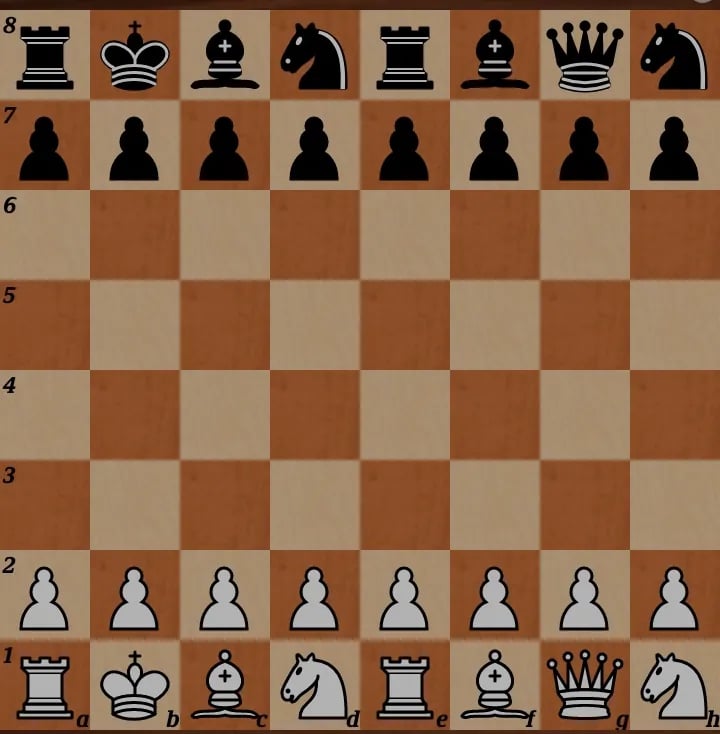
Chess 960:
Any discussion on Chess variants is incorrect if it begins with anything other than Chess 960. Originally properly developed by the Chess legend Bobby Fisher, this variant is the first officially recognized Chess variant. It is without any doubt, the most popular variant aside form the standard Chess.
Fisher had formalized this variation to reduce the high dependency of Opening Theory in a game of Chess; something he advocated with his heart and soul. It is worth mentioning that randomizing the main pieces had long been known as 'shuffle chess', but Fischer introduced new rules for the initial random setup, "preserving the dynamic nature of the game by retaining bishops of opposite colors for each player and the right to castle for both sides". The result is 960 distinct possible starting positions.
In 2008, FIDE added Chess960 to an appendix of the Laws of Chess. The first world championship officially sanctioned by FIDE, the FIDE World Fischer Random Chess Championship 2019, brought additional prominence to the variant. It was won by Wesley So. In 2022, Hikaru Nakamura won the second edition In 2026, Magnus Carlsen became the new champion.
Rules Setup
Before the game, a starting position is randomly determined and set up, subject to certain requirements. White's pieces (not pawns) are placed randomly on the first rank, following two rules:
The bishops must be placed on opposite-color squares.
The king must be placed on a square between the rooks.
There are 960 possible starting positions. The starting position is usually chosen randomly by software, but can be done using multiple rolls of a standard six-sided die.
Black's pieces are placed equal-and-opposite to White's pieces. (For example, if the white king is randomly determined to start on f1, then the black king is placed on f8.) Pawns are placed on the players' second ranks as in classical chess.
After setup, the game is played the same as classical chess in all respects, with the exception of castling from the different possible starting positions for king and rooks.
Moreover, there are a few more rules for Castling too.
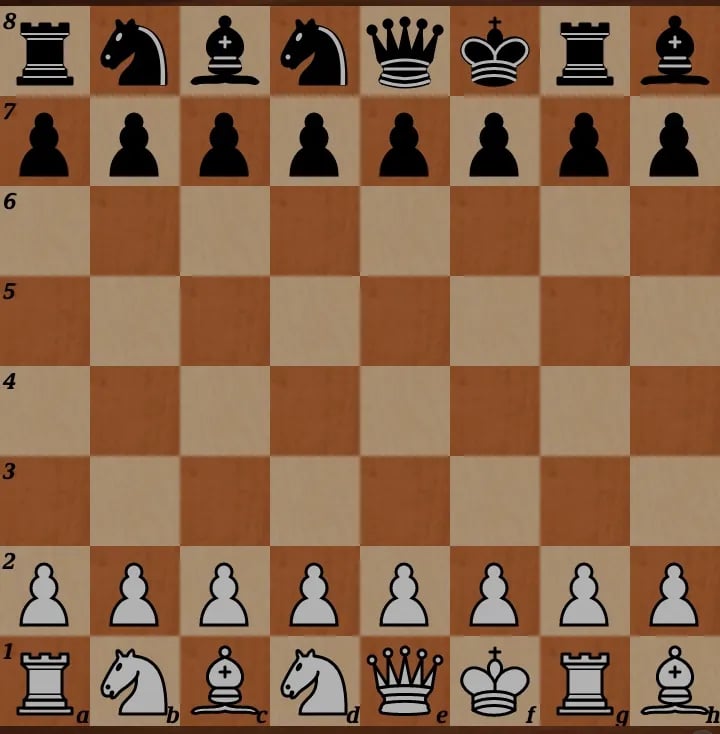
CrazyHouse Chess:
Crazyhouse is a chess variant in which captured enemy pieces can be reintroduced, or dropped, into the game as one's own, similarly to shogi. It is basically a two player variation of the Bug-House variant of Chess.
Rules of Play:
The rules of chess apply except for the addition of drops, as explained below.
A piece that is captured reverses color and goes to the capturing player's reserve, pocket or bank, where it is considered held or in hand. On any turn, instead of making a move with a piece on the board, a player can drop one of their held pieces onto an empty square on the board.
A pawn may not be dropped on the 1st or 8th ranks.
A pawn that is dropped on its 2nd rank may use its two-square initial advance; a pawn that is dropped on any other rank cannot.
When a piece that is promoted from a pawn is captured, it enters the opponent's reserve as a pawn.
Unlike in shogi, dropping a pawn on a file containing another pawn of the same color and dropping a pawn to deliver checkmate are both permissible.
Bug-House Chess:
Bughouse chess is another popular chess variant played on two chessboards by four players in teams of two. It is also known as exchange chess, tandem chess, transfer chess, double bughouse, doubles chess, cross chess, swap chess, or simply bughouse, bugsy, or bug. The name Siamese chess is also used but should not be confused with Thai chess. Normal chess rules apply, except that captured pieces on one board are passed on to the teammate on the other board, who then has the option of putting these pieces on their board.
The game is usually played at a fast time control. Together with the passing and dropping of pieces, this can make the game look chaotic to the casual onlooker, hence the name bughouse, which is slang for mental hospital. Yearly, several dedicated bughouse tournaments are organized on a national and an international level.
Four-Player Chess
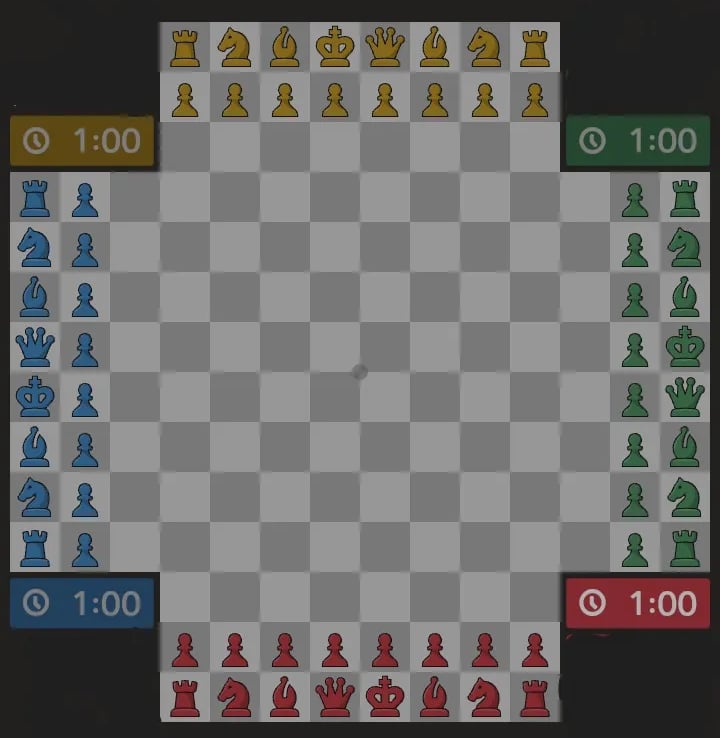
The Four Player Chess variant is yet another variant worth trying. It is basically just regular Chess turned up a notch by addition of more players.
The game features a special board typically made of a standard 8×8 square, with 3 rows of 8 cells each extending from each side, and requires two sets of differently colored pieces. The rules are similar to, but not the same as, regular chess. There are a variety of different rule variations; most variations, however, share a somewhat similar board and piece setup.
Gameplay can be in teams, typically with the two partners across from each other. It can also be free-for-all, with each of the players trying to gain a decisive advantage, with no set alliances. Free-for-all can be played for points, or till the first checkmate. Table-talk, such as move suggestions, is not allowed under the FFA rules; players must decide for themselves who, when, or how to attack.
Rules of Play:
A board made of a standard 8×8 square with an additional 3 rows of 8 cells extending from each side is what is typically used for Four-player chess. Variants vary as to where the king and queen are placed; this doesn't matter for casual play. Otherwise, pieces are set up like regular chess.
The goal is to have the most points at the end of the game:
Pawns (and promoted pawns) are worth one point
A player's queen is worth nine points
Bishops are worth five points
Rooks are also worth five points
Knights are worth three points
Checkmates (and in rare cases king captures) are worth twenty points.
Pawns promote to queens on the eighth rank, which is at the middle of the board.
When a player is checkmated, all their pieces turn grey. When this happens, they cannot move and don't give a player any points. A player is checkmated immediately; in other words, they don't have to wait for their opponents to move to be checkmated.
The game ends when three players are defeated. It also ends when there are two players left and one player has more than twenty points more than the other player (because, if they were checkmated, they would still win) In this case, the leading player may have to click a button that says "claim win".
Trying to influence another player to help you by communicating in the chat (such as saying "team with me" or "take queen") is against the rules. However, it is perfectly legal to aid another player's attacks, or choosing not to attack a player because you would think it would benefit you.
Blindfold Chess:
Blindfold Chess is one of the most hardest variants to play. In this variant, neither player can see the board or the moves played. The players have to visualize the board in its entirety just to be able to play. Usually, a mediator physically moves the pieces in case of an OTB game. The rest of the rules of play are exactly as that of standard Chess. It is worth mentioning that in most online formats nowadays, a mediator is usually not required.
To learn more about Freestyle Chess(Chess960), check our other blogs like "Freestyle Chess: The future of Chess" or visit our Play Freestyle page
Also check our other blogs on FloatChess Blogs or read other materials on our Read page.