
OPENING THEORY: SCANDINAVIAN DEFENCE
A detailed repertoire on the Scandinavian Defence
OPENING
5/3/20263 min read
Mainlines in the Scandinavian Defense
Before getting into the main lines, let’s analyze the most common Scandinavian Defense first moves.
The Scandi starts with 1.e4 d5, and that the best continuation for White is to capture the pawn with 2.exd5..
Now Black has two main options, which are:
2…Qxd5
2…Nf6
Out of these two, 2…Qxd5 is the considered the mainline.
Black has a queen in the centre of the board and it is white's turn to take advantage of it. Nc3 is the most logical move in this position.
An extremely natural and obvious move. White is immediately punishing Black for bringing out the Queen early.
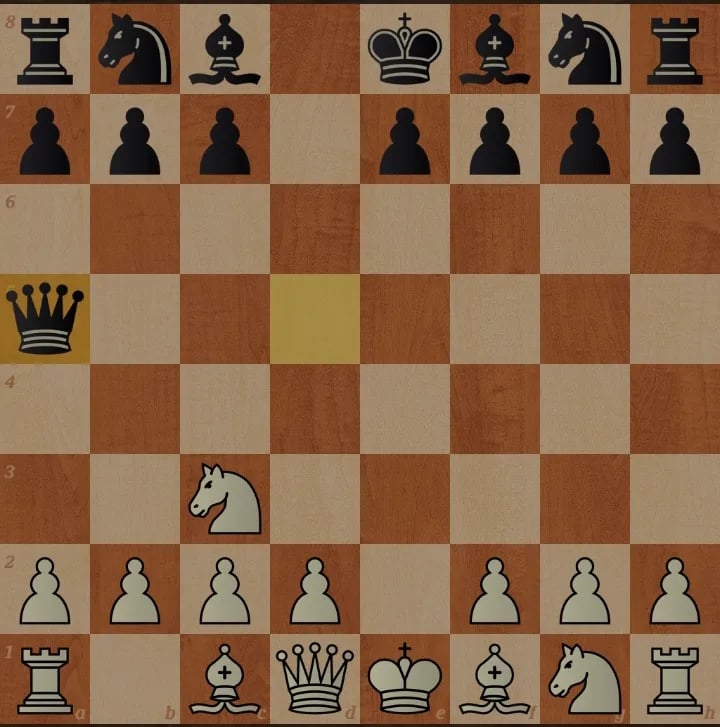
Black has two main options: 3…Qa5 and 3…Qd6. Both moves are perfectly playable.
Black simply takes his Queen out of the danger zone and is preparing to play c6 and then Qc7 at some point in the near future.
The 3...Qa5 line
The mainline continues with natural developing moves like 4.d4 Nf6
White occupies the center, and Black develops another piece.
The line goes on with 5. Nf3 Bf5 6. Bd2 c7 7. Bd3 e6 8. O-O Nbd7 and so on.
The ideas of these moves matter much more than their order in such lines. Black plays c7 to make an escape route for the queen, which usually retreats to the c7 square. c7 also helps cove the important d5 square. Black plays e6 to protect the d5 square as well as open the dark squared Bishop. black develops the Knight to d7. Black can choose to castle either side depending on his play taste and demands of the position. White usually aims for an open centre game with his more alligned pieces in the centre. This is why white often tries for a d5 break. Black on the otherhand, tries for active flank attack supported with awns on c6 and e6. However, black can also choose to simply castle his king short and play an open positon with a rather superior queen placement.
The 3…Qd6 Line
The Qd6 line is also yet another very popular line. The main ideas of this line remains same. Both sides play the most natural moves. Hoever, black has another option of fiencettoing the Bishop on g7. In such a position, black castles kingside and strikes in the centre first with moves like e5. However, this line has a few difficulties on its own. This is a very robust line with many many positional and tactical nuances.
The Old Variation: 3…Qd8
In this variation, Black does not waste time in retreating his Queen right away to its initial square. Again, the spirit of the opening is the same here as it was with 3…Qa5 and 3…Qd6. Black will play c6, Bf5 or Bg4, e6, Qc7 or Qb6, and White will try to develop its pieces as quickly as possible and castle. The 3…Qd8 line is not played much nowadays as it is very passive and black's initiative is basically lost.
To conclude:
The Scandinavian is a very robust opening and it can be a handy weapon, especially in the beginner and intermediate level. However, it is less popular at the master level as it can shave many subtle drawbacks. it is still played in that level nonetheless, to some extent.
Other sidelines:
Other lines in the Scandi include variations where white fiencettos the Bishop on g7. In such positions, Black must adopt accordingly. White often manuvres the g1 Knight to c4, through d2. Also, white can fiencetto the other dark squared Bishop. instead and castle queenside
The Scandinavian:
Here is an excellent example game played between Fabiano Caruana and Magnus Carlsen in 2014.